
Public vs Subscription NTRIP: Why Auto-Mount RTK Matters
NTRIP choice affects field accuracy
RTK correction services are now part of everyday operations in precision agriculture, drone work, surveying, and other tasks that depend on repeatable positioning. But centimeter-level results are not determined by the GNSS receiver alone. The way the system connects to NTRIP correction streams matters just as much.
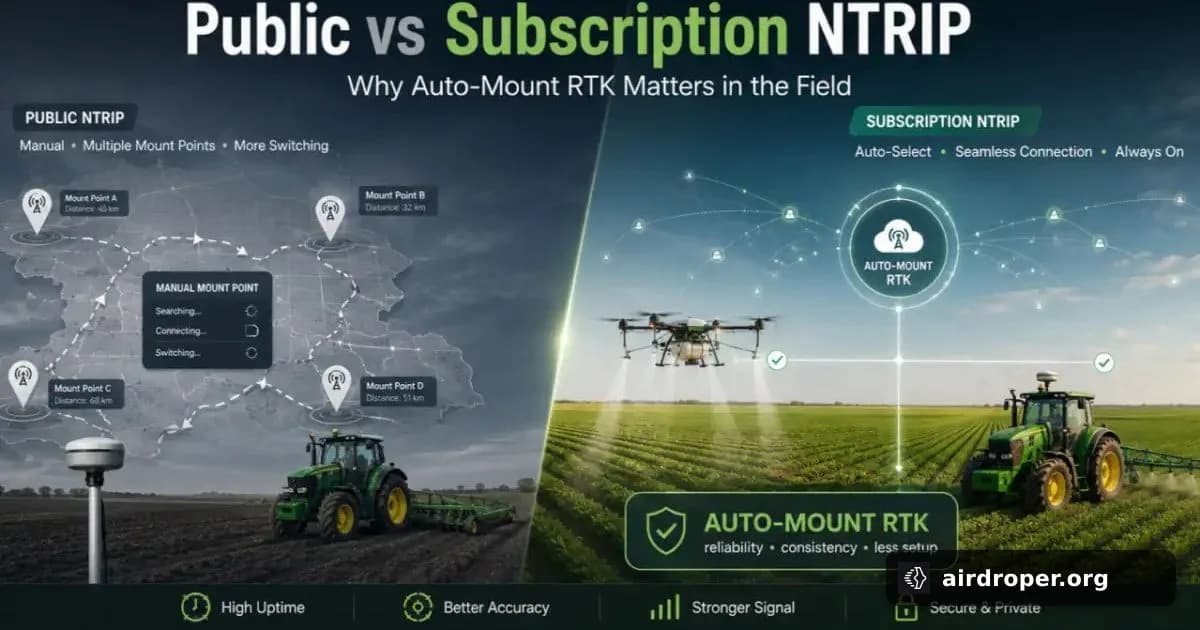
In practice, teams usually work with two models: public mount points and subscription-based services. Public streams are often easier to access, but they may offer less consistency and fewer options. Subscription services typically provide more control and support, but they also require credentials, setup, and ongoing configuration.
Why manual mount point selection can slow things down
When an operator has to choose a mount point by hand, there is always room for delay and error. The user needs to know which stream matches the correction format, whether coverage is available in the area, and whether the selected source is compatible with the equipment being used.
That becomes a bigger issue in field operations, where time matters and workflows need to stay simple. If the stream changes or the available options differ from one location to another, the setup process becomes another point of failure.
This is where auto-mount NTRIP becomes useful. Instead of relying on manual selection, the system can identify a compatible correction stream automatically. That reduces startup friction and lowers the chance of configuration mistakes before the mission even begins.
Where auto-mount RTK is most valuable
Automatic mount point selection is especially helpful in environments where machines move quickly and operators cannot spend time checking settings every time they reconnect:
- agriculture drones;
- tractors and other farm equipment;
- surveying workflows;
- mobile systems working across multiple sites.
In these cases, correction stability directly affects route repeatability, mapping quality, and application accuracy.
What it changes in daily operations
The biggest advantage of auto-mount RTK is operational simplicity. Fewer manual steps mean faster deployment and fewer setup errors. For teams working across large areas or under time pressure, that can make the difference between a smooth start and a stalled job.
It is also important to keep the role of automation in perspective: auto-mount does not improve RTK physics itself. What it does is help users reach a working correction stream faster and more reliably. In field use, that operational benefit is often just as important as receiver performance.
Bottom line
Public NTRIP can be a practical entry point, while subscription services may be better suited to controlled, professional workflows. But across both models, the trend is clear: reducing manual setup improves reliability in the field. That is why auto-mount RTK is becoming a valuable feature for teams that need consistent corrections and fast, centimeter-level positioning.
Related Posts

Comments
Sign in to leave a comment