
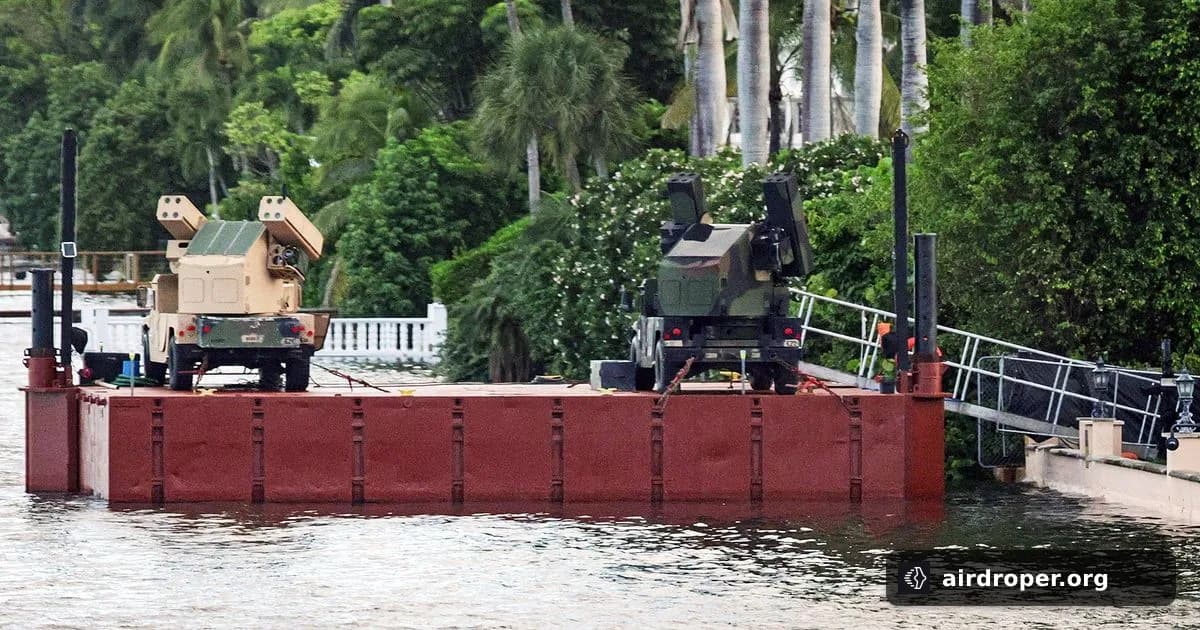
Avenger Air Defenses Guard Mar-a-Lago
What was reported
AN/TWQ-1 Avenger short-range air defense systems have been seen deployed around Mar-a-Lago in Florida. The vehicle-mounted platform fires FIM-92 Stinger missiles and is built to engage low-altitude threats at close range. According to the source, the deployment was reinforced with counter-drone fly-away sensor and jammer kits provided through U.S. Northern Command.
Why this matters
Avenger is an older system, but it remains useful in scenarios where mobility and rapid reaction matter more than long-range coverage. Its mix of guided missiles and onboard sighting equipment makes it a practical option for guarding fixed sites against helicopters, small aircraft, and other low-flying targets.
The addition of sensor and jamming tools points to a broader shift in modern site defense. Today, protecting a sensitive location is not only about stopping conventional aerial threats. It also means detecting small drones, interrupting their control links, and having a last-resort hard-kill option if needed.
Layered protection against drones
The Mar-a-Lago deployment is a clear example of layered defense in practice. A single site can combine several measures:
- detection to spot airborne objects early;
- electronic disruption to interfere with control or navigation;
- missile intercept when a target cannot be neutralized otherwise.
That layered model is increasingly common because no single countermeasure is enough in every case. Small UAVs can be hard to see, quick to react, and difficult to classify. A mixed defense package gives operators more options and reduces dependence on one tool alone.
Bottom line
The use of Avenger systems alongside counter-drone kits shows how air defense and anti-UAS protection are converging around high-value sites. For modern security planning, the lesson is straightforward: effective protection is usually multi-layered, mobile, and adaptable.
Related Posts


Comments
Sign in to leave a comment