
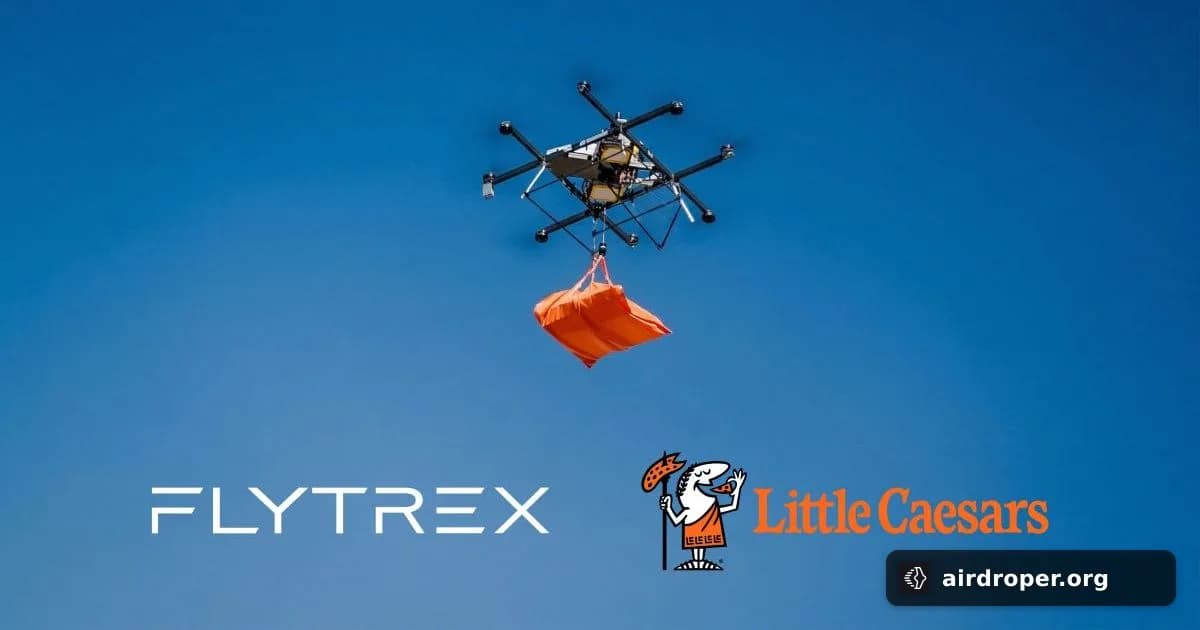
Pizza from Above: How Drones Are Reshaping Food Delivery
Food Delivery Gets Airborne
The idea sounds futuristic, but it's already being tested in American suburbs: you order a pizza, and instead of watching for a delivery car, you hear a drone descending into your backyard.
Little Caesars and drone delivery platform Flytrex are among the companies pushing this vision forward. Their model is straightforward — the order is prepared at the restaurant, secured in a purpose-built container, and carried the last mile by an autonomous drone, no driver required.
The Case for Drone Delivery
Traditional last-mile delivery has well-known pain points: traffic congestion, rising labor costs, and inconsistent delivery times. Drones address several of these at once:
- Speed — air routes are shorter and unaffected by road traffic
- Cost efficiency — autonomous systems reduce per-delivery labor expenses over time
- Lower emissions — electric drones produce significantly less CO₂ than delivery vehicles
Flytrex has already operated in select U.S. markets where regulations permit flights over residential areas.
Hurdles Still Ahead
Despite the appeal, scaling drone delivery remains genuinely difficult.
Airspace regulation is the biggest obstacle. The FAA and equivalent agencies worldwide still restrict Beyond Visual Line of Sight (BVLOS) operations, which are essential for any practical delivery network.
Weather dependency is another real constraint. Wind, rain, and fog can ground most commercial delivery drones, making reliability hard to guarantee.
Customer-side infrastructure matters too. Recipients need to be present, have an accessible landing or drop zone, and understand the handoff process — friction that doesn't exist with traditional doorstep delivery.
A Market With Long-Term Momentum
Analysts consistently rank last-mile drone delivery among the highest-potential commercial UAV applications. Suburban residential zones — with open yards and less complex airspace — are the most viable starting point for broad deployment.
For the hardware ecosystem, this growth translates into rising demand for dependable flight controllers, robust communication modules, and precision navigation systems. Delivery drones operate autonomously and repeatedly, placing higher reliability requirements on onboard electronics than many other UAV categories.
Pizza may be the headline, but the underlying logistics case applies equally to pharmaceuticals, groceries, and small parcels — all of which are already being delivered by drones in various markets globally. The question is no longer whether autonomous delivery goes mainstream, but how quickly the regulatory and infrastructure pieces fall into place.
Related Posts
Comments
Sign in to leave a comment