
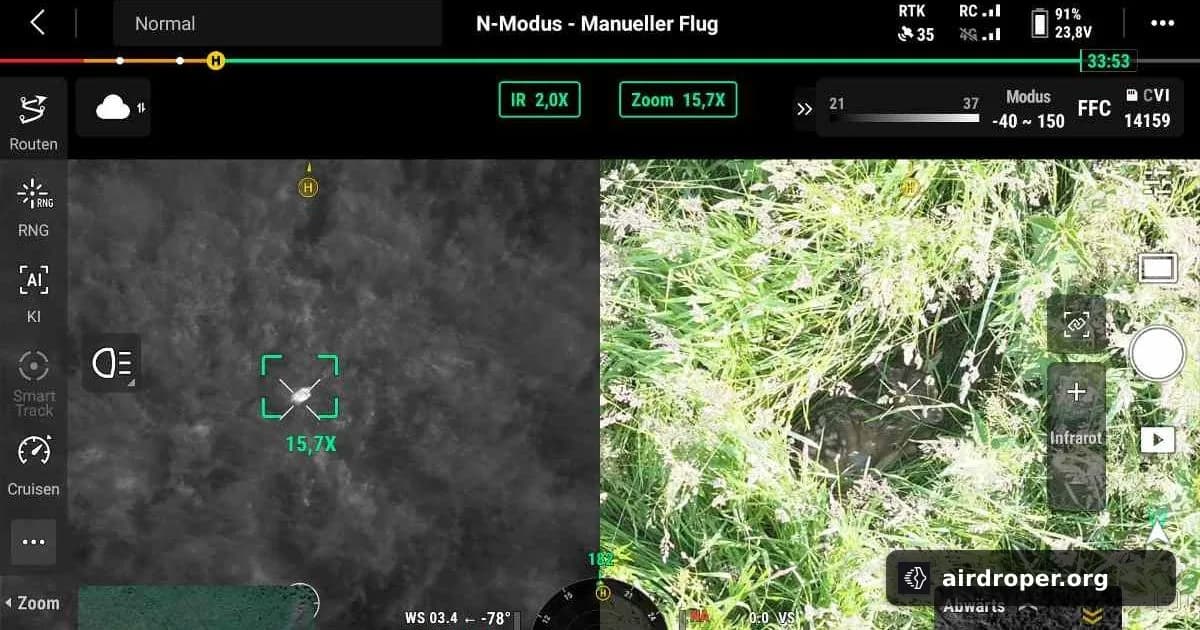
Drones vs. Mowers: Saving Fawns in Germany
A practical role for drones in spring field checks
Each spring in Germany, wildlife rescuers face the same urgent task: find hidden fawns before mowing machines enter the fields. What looks like a simple agricultural routine can become dangerous for young deer, especially when the grass is high and the animals stay completely still.
That behavior is not accidental. Fawns instinctively freeze in place, relying on camouflage rather than movement to stay safe from predators. In open meadows, however, that survival strategy works against them. From the ground, they are extremely difficult to detect, even for experienced teams.
For years, the standard approach was labor-intensive. Volunteers walked through the meadow in lines, scanning the area by eye before cutting began. It was a sensible method, but it depended heavily on manpower, time, and field size. As farms operate on tighter schedules, that approach is harder to scale.
Why aerial searches are changing the workflow
Drones offer a different perspective. From above, rescuers can inspect large areas faster and identify sections where a hidden animal may be present. That makes the pre-mowing check more efficient, especially when the field is wide and the window before harvesting is short.
This does not remove people from the process. Instead, it improves how the search is organized. Ground teams can focus on confirmed areas, while aerial inspection reduces the chance of missing an animal in dense grass. The result is a more practical workflow for both rescuers and farmers.
What makes the method useful
A drone-based rescue mission needs a few core capabilities:
- stable flight over open terrain;
- a clear top-down view of the field;
- fast deployment before mowing starts;
- coverage of large areas with limited resources.
That combination is why drones are increasingly relevant in wildlife protection. They do not replace careful human judgment, but they can make the first pass much more effective. In a situation where minutes matter, that difference is significant.
More than a farming tool
This kind of operation shows how drones are moving beyond conventional inspection and mapping tasks. In the right hands, they become part of a direct protection system for wildlife. The same platform that helps survey a field can also help prevent a tragic encounter between agriculture and nature.
For the drone industry, that is an important signal. The strongest use cases are not always the most technical ones. Sometimes the most valuable mission is simply spotting what people on the ground cannot see in time.
Related Posts
Comments
Sign in to leave a comment