
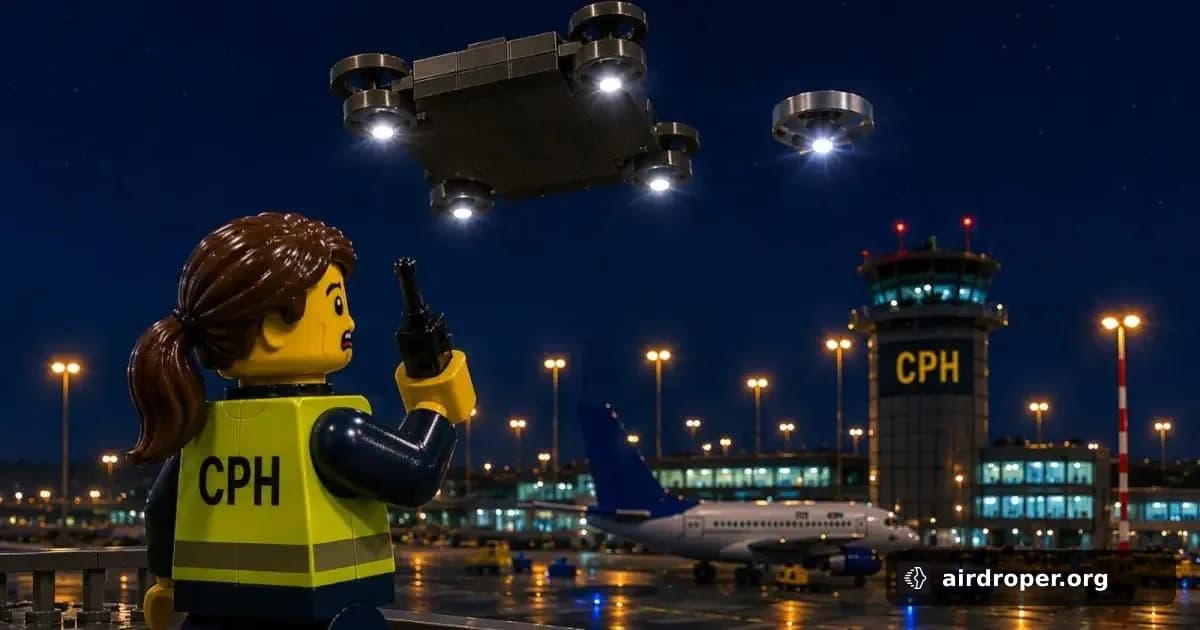
The Phantom Drone That Closed Copenhagen Airspace
When the “drone” was not a drone
The Copenhagen Airport episode is a reminder that airspace incidents can escalate quickly when a first report is interpreted as proof. Last September, sightings of drone-like objects described as resembling “robotic lawnmowers” led to a shutdown of airport operations and a large security response.
A later investigation suggests the picture may have been far less dramatic. What was taken for hostile UAVs may have been a mix of training aircraft, optical lens flares, and even the police helicopters dispatched to investigate the reports.
How a false-confirmation loop starts
The real risk in cases like this is not only the initial mistake, but the chain reaction that follows. A report triggers a search. A search produces something that looks suspicious. That new observation then seems to confirm the original assumption. In practice, a false lead can reinforce itself until it feels like established fact.
That dynamic is especially dangerous around airports. Even a brief disruption affects schedules, coordination, and the wider transport chain. If the situation is then amplified by rumors about military involvement or a passenger aircraft being targeted, the pressure on decision-makers grows even faster.
Why this case matters
The Copenhagen case highlights several weak points in modern airspace monitoring:
- visual misidentification of ordinary aircraft;
- camera artifacts and reflections;
- overreliance on early reports;
- the way multiple observers can reinforce the same error.
For airport security teams, the lesson is clear: detection is only the first step. Identification has to be verified through multiple channels, and first impressions should be treated cautiously. In fast-moving incidents, disciplined confirmation matters as much as speed.
A broader lesson for drone security
This incident does not mean drone threats are imaginary. It does show, however, that the response system itself can become a source of confusion if evidence is thin. The goal is not just to spot something in the sky, but to know exactly what it is.
As sensors, cameras, and monitoring tools become more capable, the quality of the decision process becomes more important. Sometimes the difference between a security incident and a false alarm is not the object in the sky, but the ability to identify it correctly.
Related Posts

Comments
Sign in to leave a comment