
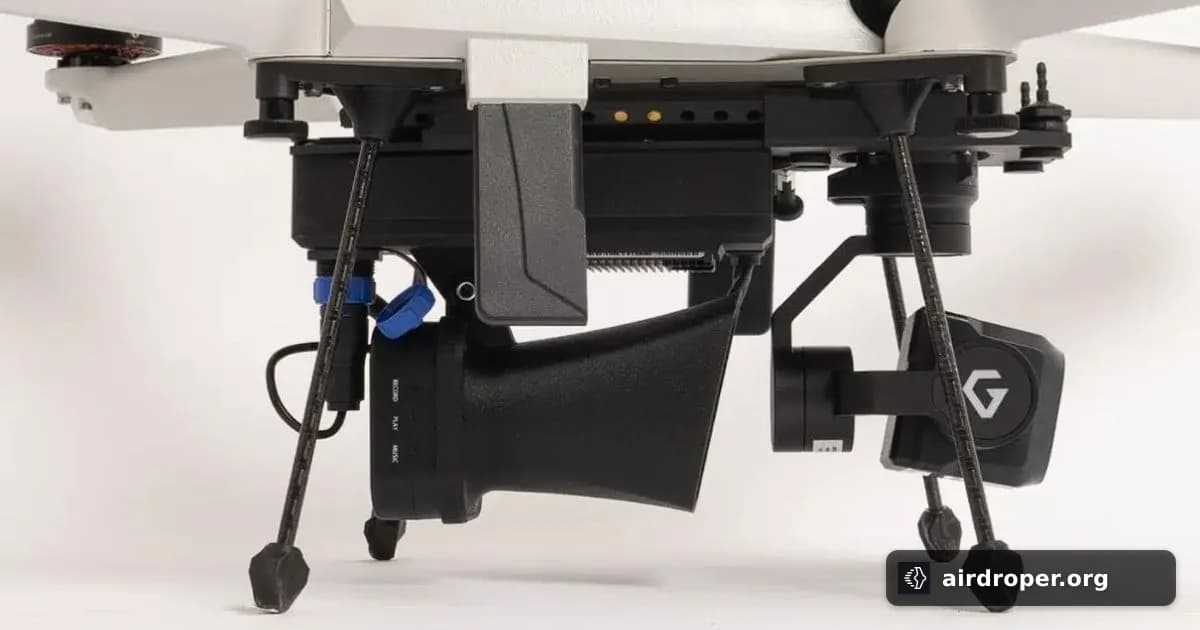
New UAV Loudspeaker Expands Airborne Operations
A loudspeaker that turns the drone into a messenger
Swedish UAV developer Airolit has introduced a new loudspeaker designed for defense and security missions. The concept is straightforward: instead of using a drone only for observation, operators can now use it to communicate directly from the air.
That matters because it expands what a UAV can do once it is already positioned over the area of interest. Beyond video and situational awareness, the platform can serve as an airborne audio channel — for warnings, instructions, or urgent announcements. In practical terms, that can reduce the need for personnel to move closer to a potentially risky location.
Why this kind of payload matters
For UAV operators, every added payload comes with trade-offs in weight, power consumption, and mission endurance. Even so, modules like this show where the market is heading: from drones as passive sensors to drones as active mission tools.
A loudspeaker payload can be useful in several scenarios:
- perimeter security and access control;
- public or crowd notifications during an incident;
- search and rescue operations;
- situations where ground access is limited or unsafe.
In each case, the value is speed. A drone can quickly reach the right position and deliver the message to the people who need to hear it.
A broader shift toward multifunctional UAVs
This launch reflects a broader trend in defense and security robotics: UAVs are increasingly treated as flexible carriers for mission-specific equipment. Depending on the task, the same airframe may support a camera, thermal sensor, relay, or audio system.
For integrators and operators, that means the demand is moving toward adaptable platforms that can be configured quickly. The result is a more practical model of UAV use — not just to see what is happening, but to influence what happens next.
Airolit’s new loudspeaker fits neatly into that direction, showing how specialized payloads can turn a drone into a direct interface between the operator and the field.
Related Posts
Comments
Sign in to leave a comment