
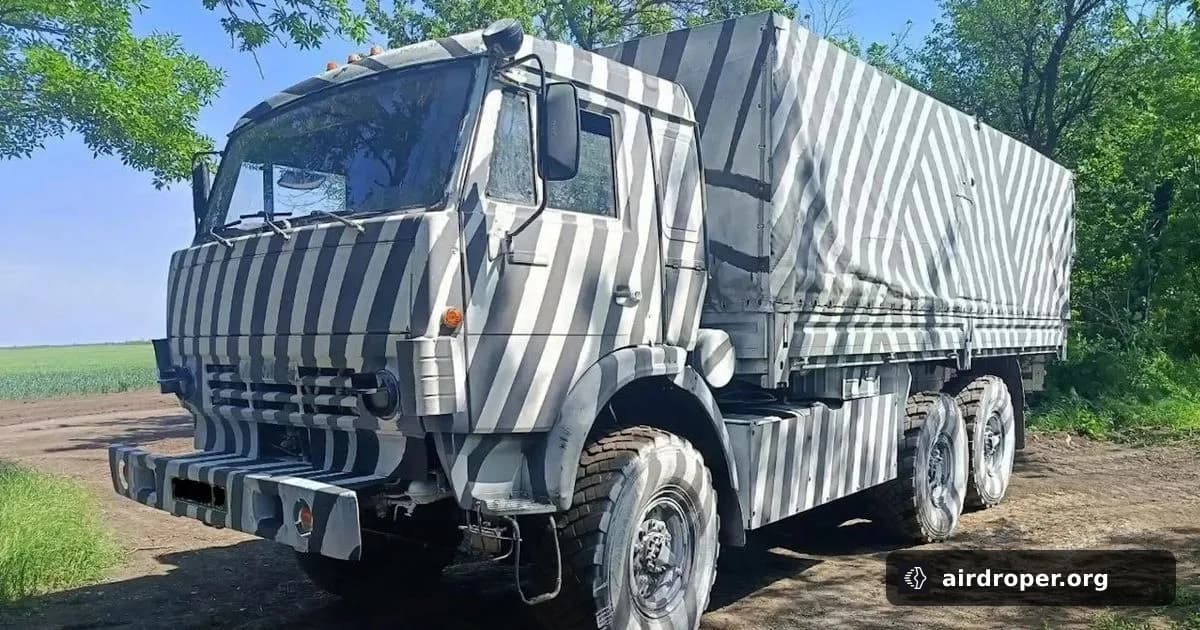
Russian Trucks Use Dazzle Paint Against Drones
Camouflage is now aimed at algorithms
Reports of Russian trucks painted in a high-contrast “dazzle” pattern point to a broader shift in battlefield concealment. This kind of paint scheme is not meant to make a vehicle disappear. Instead, it tries to break up outlines and introduce visual noise that can confuse machine-vision systems used by autonomous drones.
The basic logic is straightforward: if a drone relies on software to identify shape, edges, and motion, then bold geometric patterns may make that job harder. What looks like an eye-catching paint job to a human observer can become a problem for an onboard targeting model trying to lock onto a vehicle.
Why this matters
Autonomous and semi-autonomous UAVs are becoming a more serious challenge because they do not depend entirely on manual control. Their onboard systems can process imagery, compare patterns, and make targeting decisions with limited human input. That changes the meaning of camouflage.
Traditional concealment was mainly designed to reduce visibility to the human eye and to observational sensors. Now, it also has to work against computer vision. In that context, “dazzle” paint reflects a simple but important idea: if you cannot hide a vehicle completely, you can still make it harder for the drone to understand what it is seeing.
This is especially relevant for trucks and other large vehicles. Their shapes are easy to detect from the air, and they present broad surfaces where contrasting colors and jagged lines can alter how an algorithm interprets contours.
What the trend suggests
The use of disruptive paint highlights several developments:
- camouflage is being adapted for AI-enabled drones;
- visual deception is becoming more algorithm-focused;
- counter-UAV measures are expanding beyond traditional air defense and electronic warfare.
That said, this approach is not a universal solution. Its effectiveness depends on the drone’s targeting software, the quality of its training data, and how the system handles unusual visual patterns. For some models, the effect may be meaningful; for others, only limited.
Even so, the move is revealing. It shows that the contest between drone targeting and vehicle concealment is no longer just about line of sight. It is increasingly about how machines interpret what they see.
Related Posts
Comments
Sign in to leave a comment