
Laser Weapons vs. Drones: How the US Navy Is Testing LOCUST on a Supercarrier
Shipboard Lasers: A New Frontier in Anti-Drone Defense
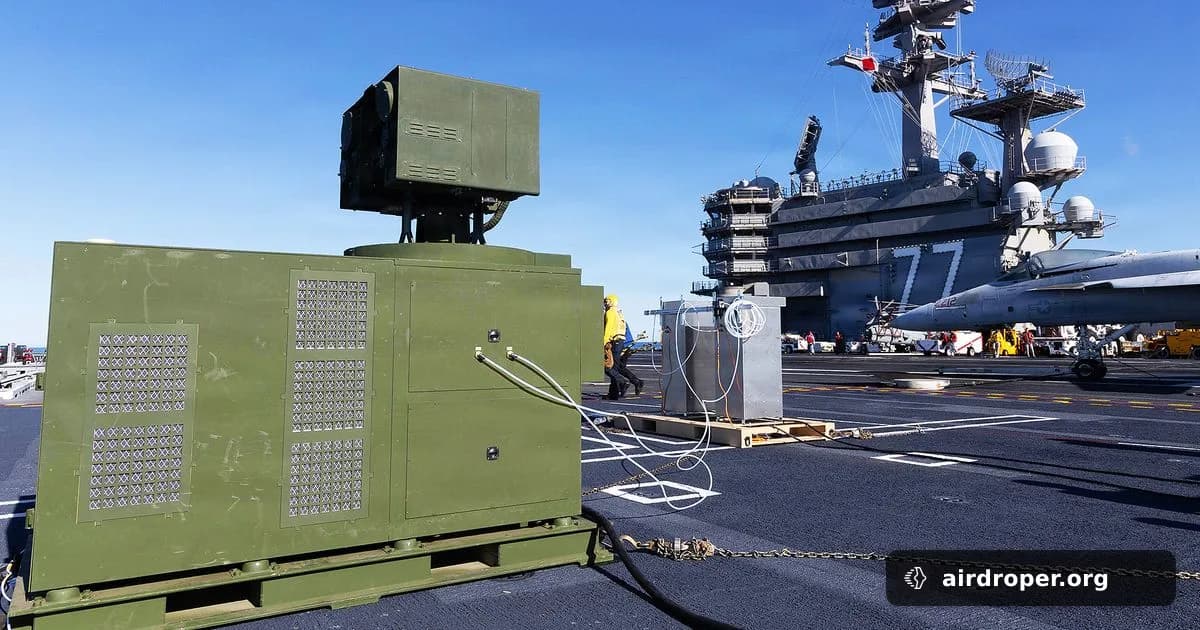
The US Navy recently conducted live-fire tests of a laser weapon system aboard the nuclear-powered supercarrier USS George H.W. Bush. The system, known as LOCUST, is designed to engage and destroy unmanned aerial vehicles — part of a broader naval strategy to counter the growing drone threat to large surface vessels.
Why Lasers Make Sense for Ship Defense
Conventional air defense systems — missiles and gun-based CIWS — are proven and reliable, but they come with a significant economic drawback: the cost per engagement can dwarf the value of the drone being shot down. Laser weapons offer a fundamentally different equation:
- Cost per shot — essentially the price of electricity
- Magazine depth — unlimited as long as the ship's power plant is running
- Precision — high, with minimal collateral fragmentation risk
- Speed of engagement — instantaneous, as the beam travels at the speed of light
Real Limitations That Can't Be Ignored
Despite the advantages, directed-energy weapons face challenges that prevent them from replacing conventional systems anytime soon.
Effective range remains a key constraint. Atmospheric conditions — rain, fog, salt spray, and humidity — all degrade laser beam coherence. In a maritime environment, where weather is unpredictable, this is a critical operational limitation.
Dwell time is another factor. Lasers don't destroy targets instantly — they heat structural components until they fail. Against fast-moving or hardened targets, this window may not be long enough to guarantee a kill.
Thermal management is an engineering challenge that scales with power output. High-energy lasers generate substantial waste heat that must be dissipated, adding complexity and reducing system reliability during sustained engagements.
A Layer, Not a Replacement
The practical role of laser weapons is best understood as an additional defensive layer within a tiered air defense architecture. Different systems handle different threat profiles at different ranges — and lasers fill a specific niche.
They are particularly well-suited against:
- Small commercial or hobbyist drones
- UAV swarms attempting to overwhelm traditional defenses
- Optical sensors and cameras aboard reconnaissance UAVs
Testing aboard an active carrier is significant because it validates performance in a real operational environment — one filled with vibration, electromagnetic interference, and spatial constraints that laboratory conditions can't replicate.
A Global Race
The US Navy is not alone in pursuing shipboard laser weapons. The UK, Israel, China, and several other nations are advancing similar programs. The convergence of investment signals broad consensus within the defense community: directed-energy weapons will be an essential component of next-generation UAV defense systems — even if they're not yet ready to stand alone.
Related Posts

Comments
Sign in to leave a comment